The marks told us what went wrong. They told us too late.
FlashShare began at a boarding school in Melaka with two students who were tired of finding weak topics on the paper itself. We built the feedback loop we wished we had before SPM.
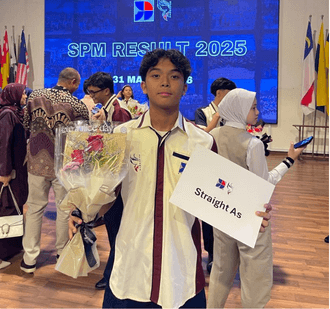
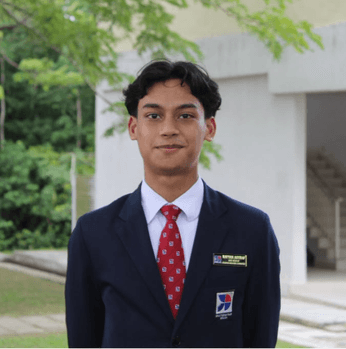
A comforting equation stopped working.
At thirteen, Aufa sat at a desk at boarding school comparing results with his friends. They had worked hard. So had he. Some were holding 4.0s. He was near the bottom.
Until then, studying had seemed like a simple equation: effort in, results out. Boarding school dismantled it. Surrounded by students who were equally capable and often equally relentless, effort alone could no longer explain the gap.
The marks were honest. They were also late. They identified the weaknesses after the test had already converted them into a result.
Effort without direction was wasted motion.
So he stopped treating studying as a test of endurance and started treating it as a system.
Years later, the same problem was sitting at every desk.
During SPM, Aufa and Rayyan watched friends reread the same chapters, produce another set of notes and still lose the same marks. Nobody lacked pressure. Nobody needed to be told to care more.
What students lacked was a useful signal between the study session and the result. Hours could be counted. Pages could be highlighted. Familiarity could feel like understanding. But none of them answered the question that mattered at ten o'clock on a Tuesday night:
What should I study next?
The result slip could explain yesterday. We wanted something that could improve tonight.
We started with the smallest useful intervention.
The first version of FlashShare was a spaced-repetition flashcard product for Malaysian students. It had a practical job: put the right question in front of the student before the memory disappeared, using material organised around the papers we actually sit.
Foreign tools offered strong scheduling but little local structure. Local platforms offered familiar content but less help understanding memory. We wanted both, without asking students to assemble the system themselves.
The full product walkthrough lives on the homepage.
Then the answers became more important than the cards.
Every response left a small piece of evidence: the concept tested, whether it could be recalled, how confidence compared with accuracy, how long the answer took and whether the memory remained stable over time.
Put together, those signals could do more than schedule another card. They could show a student how their learning was changing. They could show a teacher where a class was quietly falling behind. They could make the next hour less arbitrary.
That insight became FlashMetrics, the analysis layer inside the wider FlashShare study system.
- Biology Form 4 · Bab 3What is osmosis?The net movement of water molecules from a region of higher water potential to a region of lower water potential, through a selectively permeable membrane.AgainHardGoodEasy
- learning_events · 1 row
- concept
- Osmosis
- topic
- Biology F4 · Bab 3
- correct
- true
- rating
- good
- elapsed
- 8 days
- scheduled
- 6 days
Recalled after a longer gap than scheduled: strong evidence. - FlashMetrics · BiologyBiology is strong, but Bab 3 is fading.
- 4 of 12 Bab 3 cards at risk of being forgotten
- Recall on the chapter 64%, down from 78% two sessions ago
- Osmosis itself is secure; active transport is where recall drops
Confidence · Developing · 12 cards behind this - Next actionReview Bab 3 today (5 due), then test it again in 3 days.Reassessed after your next session on this chapter · 12 cards
Faithful to the app; figures illustrative. The card is real, from the Biology Form 4 deck.
The first 342 students replaced opinions with behaviour.
FlashShare entered a closed beta at a boarding school in Melaka. The value of the pilot was not the size of the number. It was the chance to observe a real cohort: what students opened, what they skipped, what confused them, what made them return and what teachers needed to see.
The product is still early. That is precisely why the pilot matters. It turns confident assumptions into questions the company can answer with evidence.
- 342
- Students in the first beta
- In-house
- Built and shipped
- 1
- School environment
- Student + teacher
- Workflows live
342 = registered accounts on the closed beta, as of 4 September 2026. Registered accounts are not the same as active weekly learners. Shipping record →
Two students close enough to the problem to keep being corrected by it.
Aufa and Rayyan met at school, sat the same exam system and came away with the same frustration from different angles. Aufa builds the product and learning systems. Rayyan builds the relationships and operations that carry it into schools.
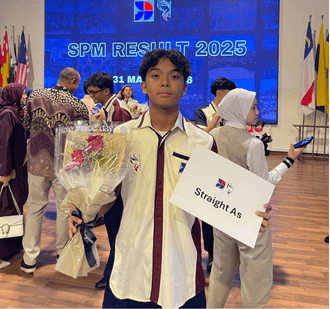
Now studying AUSMAT at Sunway College. Aufa leads product, engineering and FlashMetrics. He designed and built the first product in-house.
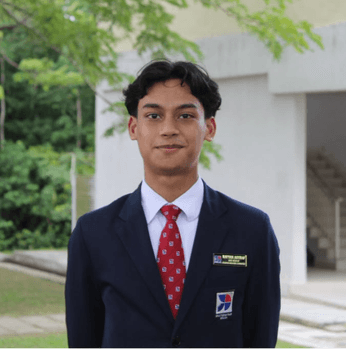
Now studying A-Levels at Taylor's College. Rayyan leads school relationships, marketing and operations.
Our age is not the reason to trust us. Our proximity to the problem is the reason to test what we have built.
The result should never be the first time a student understands their learning.
We are building toward a living model of the learner: what they know, what is fading, how their habits are changing and which next action has the highest value.
For students, that means less guessing. For teachers, earlier and more useful signals. For schools, a clearer view of where support is needed before the marks make it obvious.
Flashcards were the beginning because they turn memory into evidence. They are not the destination. The destination is the performance network for students: a system in which every useful study action makes the next one clearer.